Animating in 3D
A 3D effect is still a frame-by-frame effect. Bodies move a little every frame, either because your code moves them or because they're playing tweens. This chapter covers both, how tweens are timed, and how to hand the text back to the ordinary 2D engine once the 3D part is over.
The idea
There are two ways to animate a body, and they work together:
- Step by step: your
__next__changes the body directly, withrotate,move_by,set_rotationand the rest. You're in full control, frame by frame. Use this when the motion depends on something else in the effect. - Tweens: you describe a change once, such as "two turns about y over 120 frames, easing out", and the space plays it a frame at a time. Use this for motion you can describe up front.
Tweens queue. Each one starts when the one before it finishes, so a body's queue is its script. A tween queued with
together=True joins the one before it and runs at the same time.
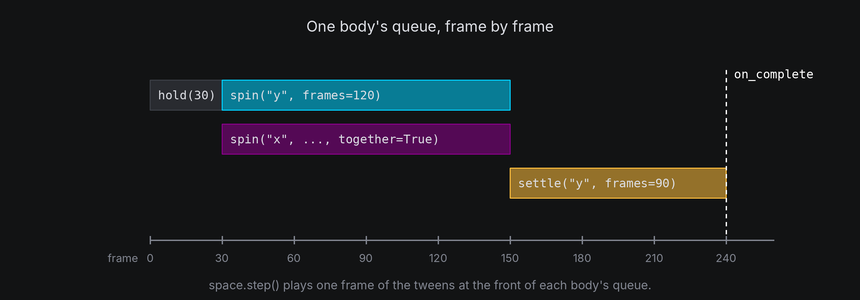
Tweens add their change to the body rather than setting it, so step-by-step calls and tweens combine. A spin keeps turning a body that your code is also nudging.
Each tween has a length in frames and an optional easing function, the same ones paths use (see Motion). Easing changes how the motion is spread over its frames, not how long it takes.
In TTE
The Handoff example flings the text plane far away, brings it back with a spin that settles exactly at rest, and then
releases every character to an ordinary 2D hop. Save it as handoff.py:
"""Handoff: the text tumbles in from far away, settles flat, and then hops as an ordinary 2D effect.

An Effect Guide example for the Animating in 3D chapter.
"""

from __future__ import annotations

from dataclasses import dataclass

from terminaltexteffects import Coord, EffectCharacter, EventHandler, easing
from terminaltexteffects.engine.base_config import BaseConfig
from terminaltexteffects.engine.base_effect import BaseEffect, BaseEffectIterator
from terminaltexteffects.engine.space3d import Body, Space3D, rotation_about
from terminaltexteffects.utils import argutils


def get_effect_resources() -> tuple[str, type[BaseEffect], type[BaseConfig]]:
    """Return the command name, effect class, and configuration class TTE registers."""
    return "handoff", Handoff, HandoffConfig


@dataclass
class HandoffConfig(BaseConfig):
    """Configuration for the Handoff effect."""

    parser_spec = argutils.ParserSpec(
        name="handoff",
        help="The text tumbles in, settles flat, and then hops as an ordinary 2D effect.",
        description="handoff | The text tumbles in, settles flat, and then hops as an ordinary 2D effect.",
        epilog="Example: tte --canvas-width 80 --canvas-height 24 --anchor-text c handoff",
    )


class HandoffIterator(BaseEffectIterator[HandoffConfig]):
    """Produce the frames of the Handoff effect."""

    def __init__(self, effect: Handoff) -> None:
        """Mount the text on a plane, push the plane away, and queue its return."""
        super().__init__(effect)
        self.space = Space3D(self.terminal)
        self.plane = self.space.body()
        characters = [c for c in self.terminal.get_characters() if c.input_symbol != " "]
        # Anchors are made at the body's rest pose, so each one meets its character's input cell at rest.
        self.plane.add_chars(characters, self.plane.text_plane(characters))
        for character in characters:
            self.terminal.set_character_visibility(character, is_visible=True)
            self.active_characters.add(character)

        # Jump away at once (frames=0), then come back with a turn that ends exactly at rest.
        self.plane.set_rotation(rotation_about("x", 60) * rotation_about("y", 200)).set_position(0, 0, -300)
        self.plane.move_to(0, 0, 0, frames=150, ease=easing.out_cubic)
        self.plane.settle("y", turns=1, frames=150, ease=easing.out_cubic, together=True)
        self.plane.on_complete(self.hand_off)
        self.columns: list[list[EffectCharacter]] = []
        self.frame_number = 0

    def hand_off(self, plane: Body) -> None:
        """Release every character where it sits and give it an ordinary 2D hop."""
        plane.release_all()
        for character in self.plane_characters():
            up = character.motion.new_path(speed=0.4, ease=easing.out_quad, path_id="up")
            up.new_waypoint(Coord(character.input_coord.column, character.input_coord.row + 2))
            down = character.motion.new_path(speed=0.4, ease=easing.out_bounce, path_id="down")
            down.new_waypoint(character.input_coord)
            handler = character.event_handler
            handler.register_event(EventHandler.Event.PATH_ACTIVATED, up, EventHandler.Action.SET_LAYER, 1)
            handler.register_event(EventHandler.Event.PATH_COMPLETE, up, EventHandler.Action.ACTIVATE_PATH, down)
            handler.register_event(EventHandler.Event.PATH_COMPLETE, down, EventHandler.Action.SET_LAYER, 0)
        self.columns = self.terminal.get_characters_grouped(order="column_left_to_right")
        self.columns.reverse()

    def plane_characters(self) -> list[EffectCharacter]:
        """Return the characters that ride the plane."""
        return [c for c in self.terminal.get_characters() if c.input_symbol != " "]

    def __next__(self) -> str:
        """Play the 3D return, then start the hops one column at a time."""
        if self.space.animating or self.columns or self.active_characters:
            self.space.step()
            if self.columns and self.frame_number % 2 == 0:
                for character in self.columns.pop():
                    if character.input_symbol != " ":
                        character.motion.activate_path("up")
                        self.active_characters.add(character)
            self.frame_number += 1
            self.update()
            return self.frame
        raise StopIteration


class Handoff(BaseEffect[HandoffConfig]):
    """The text tumbles in, settles flat, and then hops as an ordinary 2D effect."""

    @property
    def _config_cls(self) -> type[HandoffConfig]:
        return HandoffConfig

    @property
    def _iterator_cls(self) -> type[HandoffIterator]:
        return HandoffIterator
set_rotation(...)andset_position(...)place the body at its starting pose at once.move_to(..., frames=0)would do the same as a tween.move_toandsettle(..., together=True)run together, so the text turns as it flies in, and lands at rest, where every character meets its input cell.on_complete(callback)runs when the last queued tween finishes, after the final pose is applied. The example releases the characters there.release_all()hands each character back on the cell its anchor reached, with nothing left of the mount, so a new path starts from exactly that cell.
Other tweens: turn_to(rotation), turn_to_rest(), scale_to(scale), hold(frames), and random_pose() and
random_position() for scattered starts. body.animating and space.animating tell you whether anything is still
queued.
Mounting mid-effect
Mounting and paths are both part of a character's Motion, so they hand off cleanly in both directions:
space.mount(character, anchor, blend_frames=30, ease=...)lets a character travel to its anchor from wherever it is, instead of jumping.- Activating a path releases the mount, and mounting deactivates the path.
- The
MOUNT_COMPLETEandMOUNT_RELEASEDevents, and theMOUNTandUNMOUNTactions, chain mounts with paths and scenes through the event handler.space.new_mount()creates a mount for theMOUNTaction without starting it.
Lifecycle
body.cancel() discards queued tweens and completion callbacks while keeping the current pose.
reset() also restores the starting pose. Both allow new tweens afterwards.
Use space.remove(body) to stop tracking a body: it cancels tweens, releases mounts, and hides
surface cells immediately. Repeated removal is harmless; a body from another space is rejected.
Removed bodies are no longer drawn or stepped and their anchors cannot be mounted again.
Create a new body to add geometry back. space.clear() removes all current bodies.
The space retains its surface-character pool for reuse; erase() alone only stops surface drawing.
Under the hood
A tween is a function of progress from 0 to 1. Each frame, step() advances the front of each body's queue by one
frame, eases the progress, and applies the change since the last frame. That's why tweens compose: each applies a
difference, not an absolute pose. settle and turn_to use Rotation.slerp to find the orientation at each step.
At cell resolution
-
Easing matters more in cells than in pixels. A linear spin starts and stops with a visible jolt, and an eased one doesn't. The Eases example gives three cubes the same quarter turns with different easing functions:

turn_to,turn_to_rest,settle,move_toandscale_totake the sameeaseargument. The example's source isdocs/effectguide/examples/3d/eases/eases.pyin a TTE checkout. - Hold a moment at rest before releasing text, so the reader sees it land. - After the hand-off, characters are ordinary characters. Their scenes, colors and layers are what you left them as, so reset anything the 3D part changed.
Waiting for a group or a blend
on_complete(callback) belongs to the last individual tween. Use
body.on_group_complete(callback) to wait for the longest tween in the last queued parallel group.
The hook runs after mount readings refresh, so it can release mounted characters at the final pose.
Groups queued after the hook are independent; cancelling or resetting discards pending hooks.
space.animating tracks body tweens. Mount travel is separate: use space.blending to wait for
active blends, or mount.blend_progress for the fraction of blend frames elapsed before easing.
Blends advance when characters tick, and a zero-frame blend reports 1 immediately.